01 / Record the arrival
Walk through the place if you can access it appropriately. Note the first visible feature, the point at which you choose a direction and any moment where the route becomes unclear. Sketch these observations in sequence rather than producing a complete inventory of objects.
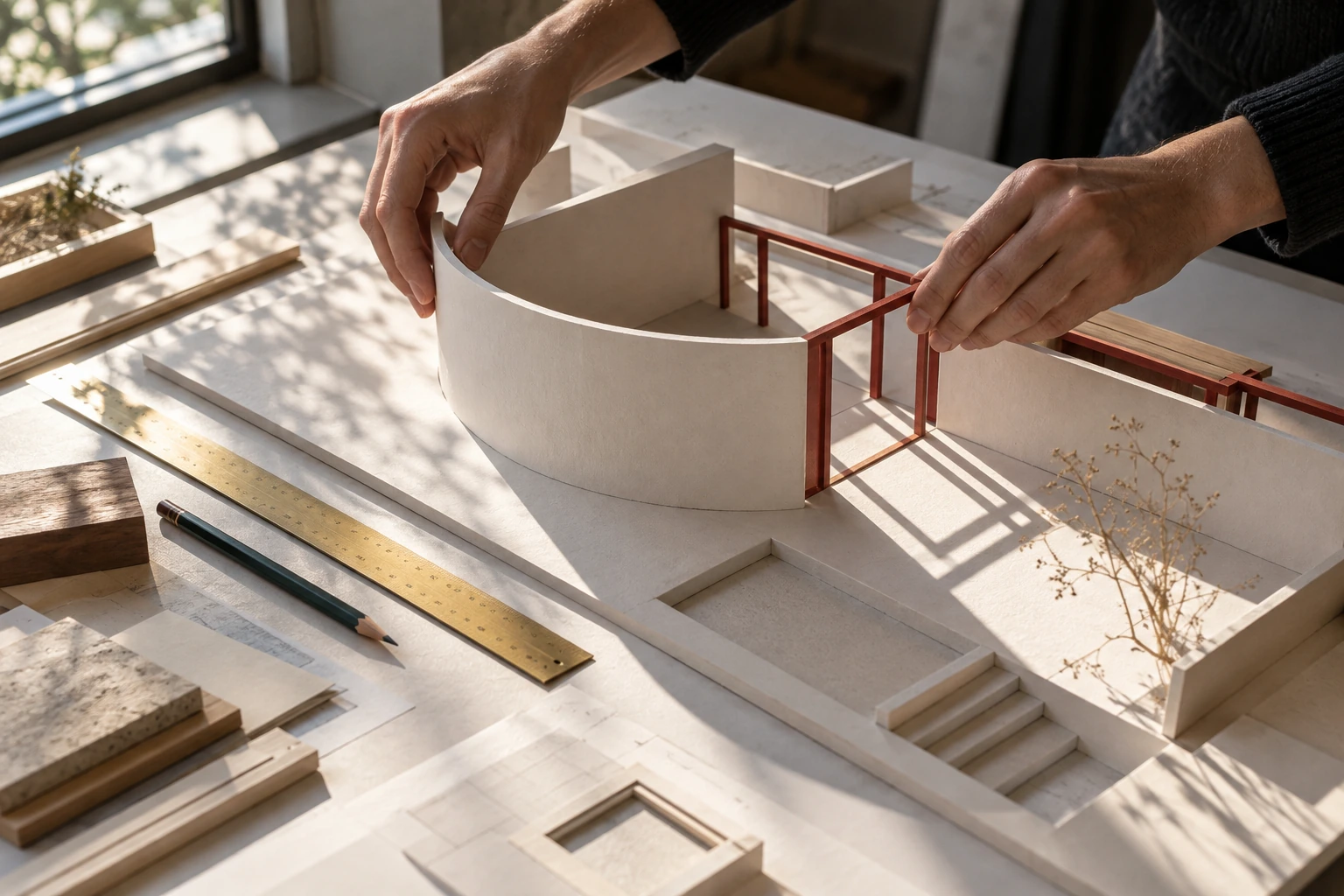
Write one question for your model. “Does the curved wall reveal the display gradually?” can be tested. “Does this look interesting?” is harder to evaluate. Choose a scale that makes the relevant distance, opening or turn large enough to see.
02 / Build a controlled comparison
Use card, paper and removable supports for the first version. Include the boundaries that affect your question and a simple scale marker for a person. Convert dimensions with the workbench, then check the arithmetic against one known measurement before cutting.
Make a second version that changes only one relationship. Move the opening, rotate a plane or widen the route. Look at both versions from the same low viewpoint. An overhead photograph may explain the plan while hiding what a person would actually encounter.
03 / Read the route in time
View the model at arrival, encounter and departure positions. Record what is visible and what remains concealed at each point. Consider alternatives: a slower pace, a different height of view, someone turning back or two people approaching together.
Photograph each version with its scale and changed variable written in your notes. Separate the observed effect from any unresolved practical requirements. An exploratory model does not establish structural stability, safe construction or accessibility. Those questions need appropriate evidence and review before a real installation is built.
Keep the question, scale, two comparable views and one sentence about the observed difference. This is a stronger record than an unlabelled polished model.
Your working checklist
- Choose the smallest useful spatial question.
- Mark a human-scale viewpoint in the model.
- Change one element between versions.
- Keep exploratory findings separate from construction decisions.